
RCC Foundation for Bolted Tanks: Why It Is Critical for Safety, Performance, and Long-Term Reliability
25 Jun , 2026, Posted by Admin
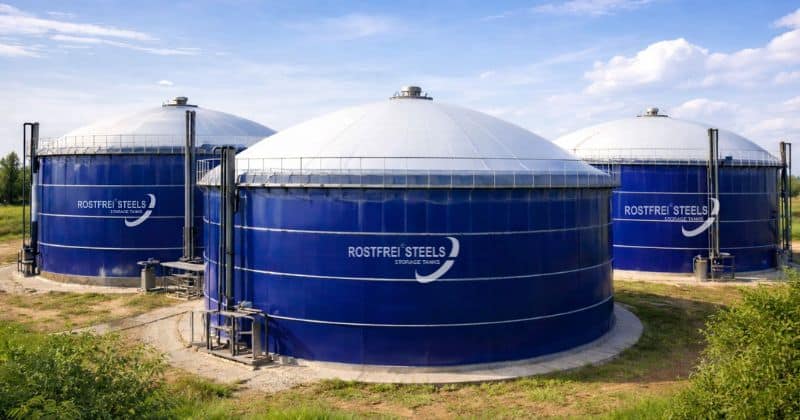
Modular or bolted steel tanks are widely used across industries for storing a variety of liquids, including fire-fighting water, potable water, rainwater, wastewater, mild chemicals, and process fluids. Their widespread adoption is mainly due to advantages such as modular construction, quick installation, scalability, and ease of transportation. However, one crucial element that often gets less attention is the RCC (Reinforced Cement Concrete) foundation, which ultimately determines the success and long-term performance of the installation.
Even a well-designed and precisely manufactured bolted tank cannot perform as intended if it is placed on a poorly designed or improperly executed foundation. In fact, many early-life failures—such as leakage, shell distortion, bolt loosening, and gasket damage—can often be traced back to foundation deficiencies.
This article highlights why a properly engineered RCC foundation is essential for bolted tanks, how it influences structural safety, operational reliability, and service life, and what key design and construction practices must be followed.
What is an RCC Foundation for Bolted Tanks?
An RCC foundation is a reinforced concrete base designed to carry the full load of the tank system. It serves as a stable interface between the tank and the ground, providing resistance against overturning, sliding, wind forces, and seismic effects.
Unlike basic PCC or earthen bases, RCC foundations offer higher strength, durability, and reliability. They are typically constructed with a pocketed arrangement to allow anchoring of the tank using mechanical or chemical fasteners.
After installation, the base is sealed using specialized cementitious materials and industrial sealants to ensure long-term stability and leak prevention.
Common RCC foundation types for bolted tanks include:
- Full circular RCC slab
- RCC ring wall foundation
The selection depends on tank size, design requirements, and application.
- Why RCC Foundations Are Critical for Bolted Tanks
- Uniform Load Distribution
Bolted tanks carry multiple types of loads, including:
Self-weight of steel components and accessories
Hydrostatic load from stored liquid
Operational and maintenance loads
A properly designed RCC foundation spreads these loads evenly into the soil. Without this uniform distribution:
Differential settlement may occur
Bottom plates may deform
Bolts and gaskets may be unevenly stressed
Over time, this can lead to leakage and structural deterioration.
Prevention of Differential Settlement
Uneven settlement is one of the most common causes of bolted tank failure. If different areas of the foundation settle at different rates:
- The tank shell may lose its circular shape
- Vertical joints experience stress concentration
- Gasket compression becomes inconsistent
- Bolts may loosen or fail
A well-engineered RCC foundation minimizes such movements and preserves the tank’s geometry throughout its service life.
Resistance to Wind Loads
Tall or exposed tanks are subject to significant wind actions, including:
- Overturning moments
- Horizontal shear forces
- Uplift at the base
RCC foundations provide the necessary mass and rigidity to counter these forces. Embedded anchor bolts further secure the tank structure, preventing uplift or sliding during high wind events.
This becomes especially important for:
- Fire water storage tanks
- Elevated or tall tanks
- Coastal or cyclone-prone installations
- Seismic Safety
In earthquake-prone regions, tanks experience dynamic forces caused by ground motion and liquid sloshing. These forces act in multiple directions and can be severe.
A properly designed RCC foundation helps by:
- Absorbing and distributing seismic energy
- Preventing sliding or overturning
- Maintaining anchor bolt integrity
Without adequate foundation design, even moderate seismic activity can lead to:
- Shell buckling
- Anchor bolt failure
- Complete structural collapse
- Ensuring Bolt and Gasket Performance
Bolted tanks depend heavily on:
- Controlled bolt tightening
- Uniform gasket compression
A perfectly level RCC foundation ensures:
- Proper alignment of bottom plates
- Consistent joint compression
Even minor unevenness can result in:
- Unequal bolt stresses
- Early gasket failure
- Persistent leakage problems
Therefore, strict control of foundation level tolerance is essential.
Support for Anchor Bolt System
Anchor bolts are critical for resisting uplift and lateral forces. RCC foundations allow:
- Accurate bolt positioning
- Proper embedment depth
- Adequate pull-out and shear resistance
Weak or poorly constructed foundations can lead to anchor failure under extreme conditions.
Compliance with Standards
RCC foundations for bolted tanks are typically required by major design codes and standards such as:
- AWWA D103 (Bolted Steel Tanks)
- IS 3370 (Concrete Structures for Liquid Retention)
- IS 456 (Concrete Design Code)
- Local fire and municipal regulations
Non-compliance may result in:
- Inspection rejection
- Legal or insurance complications
- Increased safety risks
- Types of RCC Foundations for Bolted Tanks
- Full RCC Slab Foundation
A continuous circular slab supporting the entire tank base.
Advantages:
- Even load distribution
- Excellent settlement control
- Suitable for large tanks and weak soils
Applications:
Fire water tanks
Potable water tanks
Chemical storage tanks
RCC Ring Wall Foundation
A circular RCC ring supports only the tank shell, while the interior is filled with compacted soil or PCC.
Advantages:
More economical for large diameters
Efficient load transfer through shell
Limitations:
Requires good soil conditions
Less suitable for very heavy tanks
Key Design Considerations
Soil Investigation
A proper geotechnical study is essential to determine:
Safe bearing capacity
Soil composition
Groundwater level
Design assumptions must always be based on actual site data.
Load Analysis
The foundation must consider:
Full and empty tank conditions
Wind loads
Seismic forces
Combined load cases as per design codes
Flatness and Level Tolerance
High precision is required:
Typically within ±3 mm across diameter
No abrupt surface irregularities
This is critical for proper tank performance and leak prevention.
Concrete Quality and Reinforcement
Common specifications include:
M25 or higher grade concrete
Adequate reinforcement cover
Crack control reinforcement detailing
Poor workmanship can lead to cracking and long-term durability issues.
Curing and Strength
Tank installation should only begin after:
Achieving required concrete strength
Proper curing period (14–28 days, typically)
Premature loading can permanently damage the foundation.
Common Issues from Poor Foundations
Leakage despite correct tank installation
Frequent bolt tightening
Shell misalignment and distortion
Uneven settlement and cracking
Reduced operational lifespan
Often, correcting foundation defects is far more expensive than proper initial construction.
Best Practices
Follow approved structural drawings strictly
Ensure correct reinforcement placement and shuttering
Maintain strict quality control during concreting
Verify dimensions and level before tank erection
Conduct joint inspection with the tank supplier
Conclusion
An RCC foundation is not just a supporting civil structure—it is the structural backbone of a bolted tank system. It directly affects safety, durability, performance, and compliance.
A well-designed and properly executed foundation:
Prevents premature failures
Ensures leak-free operation
Extends service life
Improves safety under extreme conditions
For any bolted tank installation, the foundation deserves the same engineering attention as the tank itself.