
Fusion Bond Epoxy
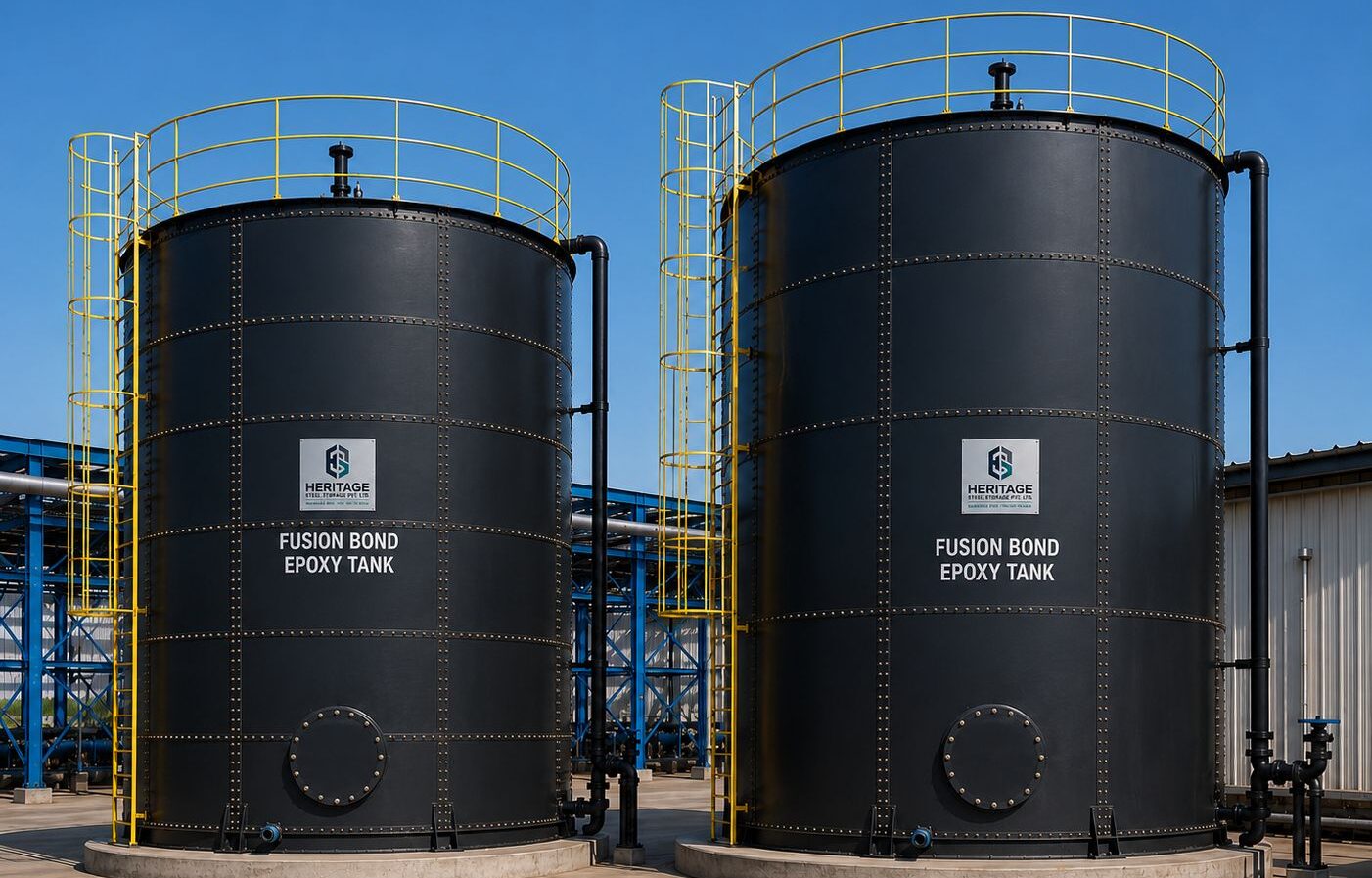
Fusion Bond Epoxy Tanks (FBE Tanks)
Heritage Steel Storage Pvt. Ltd. Fusion Bond Epoxy (FBE) Tanks are manufactured using an advanced fusion coating process, where premium Recoat epoxy is permanently bonded to mild steel sheets. This technology significantly enhances the natural strength of steel while providing exceptional resistance to corrosion, chemical attack, and harsh environmental conditions.
Unlike bare steel, which is prone to corrosion, Fusion Bond Epoxy-coated steel delivers superior durability, extended service life, and improved resistance to atmospheric weathering. The epoxy coating also broadens the acceptable pH range of stored liquids, making FBE tanks suitable for a wide variety of storage applications, including potable water, wastewater, industrial effluents, organic waste, oils, and other liquids.
FBE Tanks – Plain Sheets with PU Sealant
FBE Tanks are fabricated using plain Fusion Bond Epoxy-coated steel sheets. Panel joints are sealed using specialized nuts and bolts combined with high-performance polyurethane (PU) sealant to create a completely leak-proof structure.
Designed for larger capacities and taller installations, these tanks are suitable for heights of up to 25 meter.
Key Features
- Plain epoxy-coated steel panels
- Suitable for heights up to 25 meter
- Plate thickness ranging from 2 mm to 24 mm
- Leak-proof PU sealant joint system
- Installed on full circular reinforced concrete foundations with integrated waterproofing
- Excellent resistance to corrosion, UV exposure, and aggressive environmental conditions
FBE tanks are widely used across industrial, municipal, commercial, and agricultural sectors where long-term durability, reliability, and low maintenance are essential.
Design Standards
Heritage Steel designs and manufactures FBE tanks in accordance with internationally recognized standards to ensure safety, structural integrity, and long-term performance.
AWWA D103-09
Published by the American Water Works Association (AWWA), this standard specifies the design, fabrication, erection, and inspection requirements for bolted steel tanks used for water storage.
AS 2304:2019
This Australian Standard covers the design and construction requirements for above-ground and underground liquid storage tanks.
Compliance with these standards ensures consistent quality, reliable performance, and compatibility across a wide range of water storage applications.
Fusion Bond Epoxy Tank Manufacturing Process
Every FBE tank undergoes a carefully controlled manufacturing process to achieve maximum coating performance and structural reliability.
Manufacturing Steps
- Nut, bolt hole, and manhole drilling/punching
- Surface preparation through shot blasting
- Fusion Bond Epoxy coating application
- Oven curing process
- Final quality inspection
Quality Assurance Tests
Each tank undergoes rigorous quality inspections, including:
- Spark Test
- Dry Film Thickness (DFT) Test
- Impact Test
- Visual Inspection (for liner tanks)
- Light Test (for liner tanks)
Installation Process
A. Top-to-Bottom Assembly
Installation begins with the assembly of the roof and top ring. Hydraulic jacks are then used to lift the structure while additional shell rings are progressively installed underneath.
B. Ring Installation & Accessories
As the tank is elevated, new shell rings are added from the bottom. Accessories such as ladders, manholes, nozzles, platforms, and other components are installed according to the approved design.
C. Anchoring
After complete assembly, the tank is securely anchored to the reinforced concrete foundation using J-bolts or chemical anchors to ensure resistance against uplift, wind, and seismic forces.
Roof Options
Heritage Steel offers multiple roofing systems to suit different applications:
- Dome Roof (ZA / FBEC)
- Conical Roof (ZA / FBE / GFS)
- PVC Double Membrane Roof
- GFS Fixed Leak-Proof Roof
- Geodesic Roof
Material Specifications
Component Standard Steel Sheets IS 2062 Nuts & Bolts ISO 898-1 Anchors Grade 8.8 PU Sealant EN 1186, EN 13130, CEN/TS 14234, ISEGA Certificate No. 46763 U18 Wastewater Applications Report No. 36142/98