
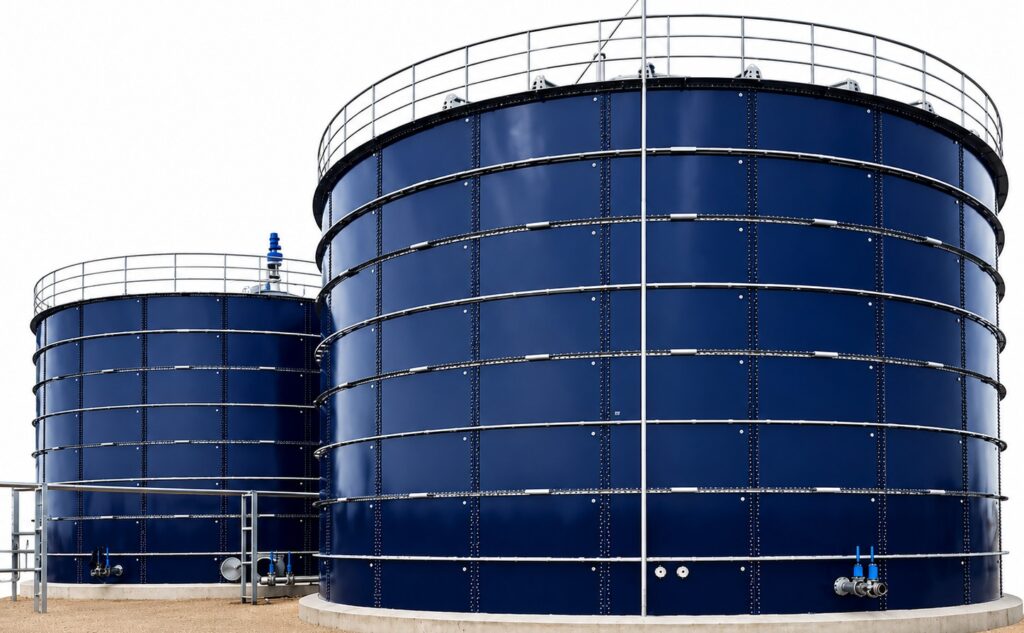
Glass-Fused-to-Steel (GFS) Tanks
Glass-Fused-to-Steel (GFS) tanks, also known as Glass-Lined Steel (GLS) tanks, represent one of the most advanced and reliable storage solutions available today. Manufactured by fusing a specially formulated glass enamel to high-tensile steel at high temperatures, these tanks combine the structural strength and flexibility of steel with the exceptional corrosion resistance of glass.
The glass enamel forms a permanent, inert barrier that protects the steel from corrosion, eliminating the need for future painting or protective coatings. This fusion technology also enables the tanks to withstand a wider range of pH levels, making them suitable for storing a variety of industrial, municipal, and agricultural materials.
Glass-Fused-to-Steel technology is applied to both the interior and exterior surfaces of the panels, ensuring superior resistance to corrosion, abrasion, chemicals, and harsh environmental conditions. The result is a durable, low-maintenance storage solution with an extended service life and consistently reliable performance.
Heritage Steel Glass-Fused-to-Steel Tank Variants
Heritage Steel offers two types of Glass-Fused-to-Steel (GFS) Tanks to meet diverse application requirements:
1. GFS Tanks with Sealant
These tanks incorporate high-performance sealants at all panel joints and seams, providing a secure, leak-proof structure with excellent corrosion protection and long-term reliability.
2. GFS Tanks with Liner
These tanks feature a specially engineered internal liner that provides an additional protective barrier between the stored material and the tank surface, enhancing durability and extending the tank’s operational life.
Benefits of the Internal Liner
The internal liner acts as a protective shield against chemical reactions, corrosion, abrasion, and contaminants. It enhances the tank’s resistance to aggressive media, minimizes maintenance requirements, and significantly extends the service life of the storage system, making it ideal for demanding industrial and process applications.
International Standards for Glass-Fused-to-Steel (GFS) Tanks
1. AWWA D103
AWWA D103, published by the American Water Works Association (AWWA), provides comprehensive guidelines for the design, fabrication, construction, and inspection of factory-coated bolted steel tanks used for water storage. The standard ensures structural integrity, durability, and long-term performance for municipal and industrial water storage applications.
2. FM 4020
FM 4020 is a standard developed by FM Global, a leading international property insurance and risk management organization. It specifies the design and construction requirements for fire protection water storage tanks.
The standard covers key aspects including:
- Tank materials and construction
- Structural design criteria
- Seismic design requirements
- Corrosion protection
- Performance and quality testing
Compliance with FM 4020 helps ensure the safety, reliability, and effectiveness of fire water storage systems.
Glass-Fused-to-Steel (GFS) Tank – Process & Technology
The manufacturing of Glass-Fused-to-Steel (GFS) tanks involves a series of carefully controlled processes to achieve a durable, corrosion-resistant, and high-quality finish. Each stage is executed with precision to ensure the structural integrity and long service life of the tank.
Manufacturing Process
The typical manufacturing process includes the following steps:
- Steel plate preparation
- Drilling or punching of nut & bolt holes and manhole openings
- Pre-heating of steel panels
- Shot blasting for surface preparation
- Glass-to-steel fusion process
- Enamelling process
- Post-baking (curing)
- Final quality inspection
Quality Assurance Tests
Each panel undergoes rigorous quality inspections before dispatch. The standard quality checks include:
- Spark Test
- Dry Film Thickness (DFT) Test
- Impact Resistance Test
- Visual Inspection (for liners)
- Light Test (for liners)
These tests ensure proper coating adhesion, surface finish, coating thickness, and overall product quality.
Installation Process
A. Top-to-Bottom Assembly
The installation begins by assembling the roof and the top ring of the tank. Hydraulic jacks are then used to lift the assembled structure, allowing additional rings to be installed underneath. This top-to-bottom erection method minimizes the need for heavy lifting equipment and enhances installation safety.
B. Ring Installation and Accessories
As the tank is progressively lifted, new rings are added at the bottom until the required tank height is achieved. During this stage, all necessary accessories—including ladders, manholes, nozzles, vents, and other fittings—are installed according to the approved tank design and project specifications.
C. Anchoring
Once the tank assembly is complete, it is securely anchored to the foundation using J-bolts or chemical anchor fasteners. Proper anchoring ensures structural stability and provides resistance against uplift forces, wind loads, seismic activity, and other lateral loads, ensuring safe and reliable operation throughout the tank’s service life.