
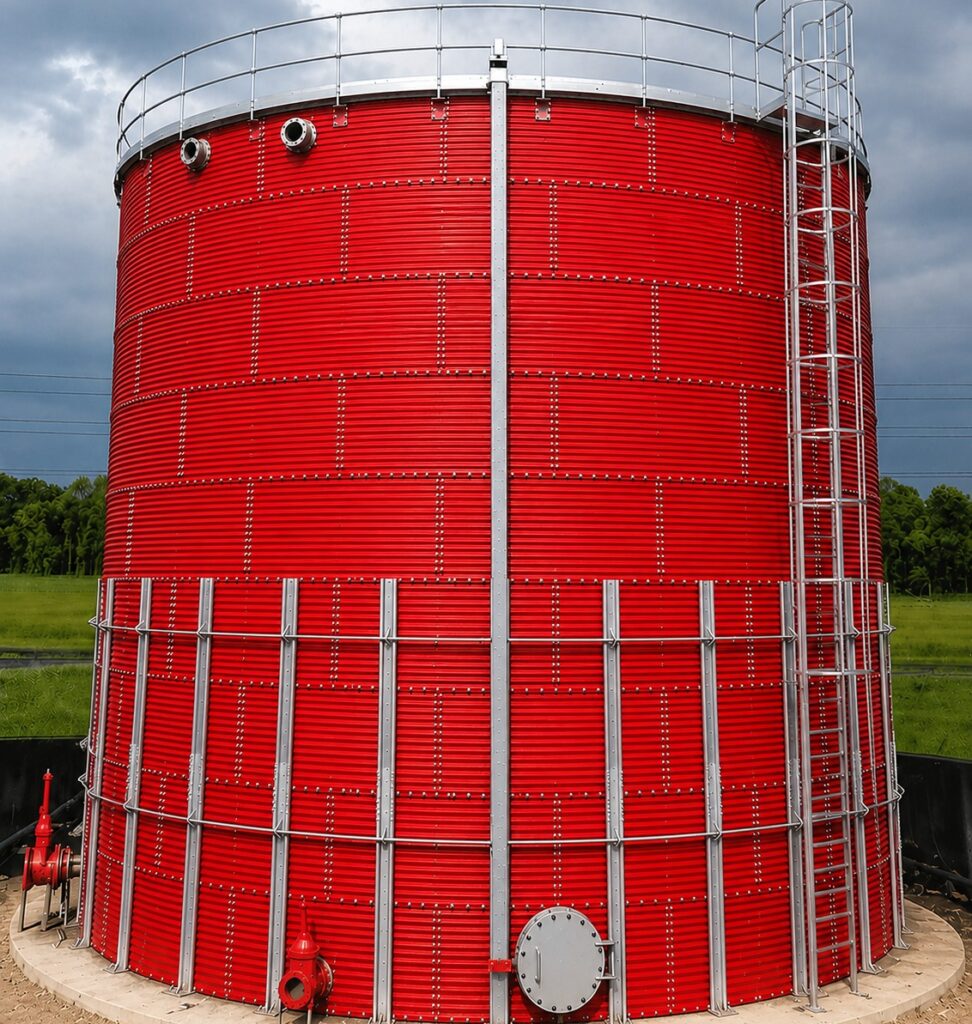
FBEC Tanks
Heritage Steel Storage Pvt. Ltd. Fusion Bond Epoxy Corrugated Liner Tanks (FBEC) Tanks are manufactured using an advanced fusion coating process, where premium Resicoat epoxy is permanently bonded to mild steel sheets. This technology significantly enhances the natural strength of steel while providing exceptional resistance to corrosion, chemical attack, and harsh environmental conditions.
Unlike bare steel, which is prone to corrosion, Fusion Bond Epoxy Corrugated Liner Tanks delivers superior durability, extended service life, and improved resistance to atmospheric weathering. The epoxy coating also broadens the acceptable pH range of stored liquids, making FBEC tanks suitable for a wide variety of storage applications, including potable water, wastewater, industrial effluents, organic waste, oils, and other liquids.
1. FBEC Tanks (Patented Heritage Steel Technology) – Corrugated Sheets with Liner
FBEC (Fusion Bond Epoxy Corrugated) Tanks are constructed using corrugated epoxy-coated steel panels. The panels are assembled using specialized nuts and bolts, while the stored liquid is contained within a high-quality membrane liner installed inside the tank shell.
This design isolates the stored liquid from the steel structure, offering enhanced protection against corrosion, chemical reactions, and external contamination while significantly extending the tank’s operational life.
Key Features
- Patented Heritage corrugated panel technology
- Suitable for tank heights up to 12 metres
- Panel thickness ranging from 0.8 mm to 2.5 mm
- Higher thickness achieved through sheet fusing technology
- Installed on reinforced concrete ring beam foundations with compacted sand filling for economical and stable construction
- Ideal for potable water, wastewater, and industrial liquid storage
Design Standards
Heritage Steel designs and manufactures FBEC tanks in accordance with internationally recognized standards to ensure safety, structural integrity, and long-term performance.
AWWA D103-09
Published by the American Water Works Association (AWWA), this standard specifies the design, fabrication, erection, and inspection requirements for bolted steel tanks used for water storage.
AS 2304:2019
This Australian Standard covers the design and construction requirements for above-ground and underground liquid storage tanks.
Compliance with these standards ensures consistent quality, reliable performance, and compatibility across a wide range of water storage applications.
Installation Process
A. Top-to-Bottom Assembly
Installation begins with the assembly of the roof and top ring. Hydraulic jacks are then used to lift the structure while additional shell rings are progressively installed underneath.
B. Ring Installation & Accessories
As the tank is elevated, new shell rings are added from the bottom. Accessories such as ladders, manholes, nozzles, platforms, and other components are installed according to the approved design.
C. Anchoring
After complete assembly, the tank is securely anchored to the reinforced concrete foundation using J-bolts or chemical anchors to ensure resistance against uplift, wind, and seismic forces.
Roof Options
Heritage Steel offers multiple roofing systems to suit different applications:
- Dome Roof (ZA / FBEC)
- Conical Roof (ZA / FBEC / GFS)
Material Specifications
| Component | Standard |
|---|---|
| Steel Sheets | AZ 150, AZ 200 |
| Nuts & Bolts | ISO 898-1 |
| Anchors | Grade 8.8 |
| Wastewater Applications | Report No. 36142/98 |
Fusion Bond Epoxy Corrugated Liner Tank (FBEC) – Process & Technology
Panel Manufacturing
Sheet Corrugation
Steel sheets are processed through precision corrugation machines to improve structural strength, flexibility, and load-bearing performance.
Cutting, Drilling & Curving
Corrugated panels are cut to the required dimensions and machined using advanced CNC drilling equipment for precise hole placement. The panels are then curved to match the required tank diameter.
Epoxy Coating Process
The coating process consists of four critical stages:
- Surface preparation through sandblasting
- Pre-heating between 200°C and 250°C
- Electrostatic application of Fusion Bond Epoxy coating
- Final curing at 150°C to 250°C to achieve permanent fusion between the coating and steel